
About Haashar · since 2000
Rooted in the mountains, working with communities for 26 years
“Haashar” is a local word for volunteerism and self-help. Since 2000 we have worked alongside rural communities in Khyber Pakhtunkhwa to manage their natural resources, build livelihoods and recover from disaster.

2000
Founded in Abbottabad
26+
Years of service
45+
Projects delivered
18
Partners & donors
90
Micro-hydel power projects


“Haashar”
A local word for volunteerism: neighbours coming together to help one another.
Who we are
A community organisation born from joint forest management
Haashar Association grew out of the GTZ/KfW-funded Siran Forest Development Project, which pioneered Joint Forest Management in Pakistan. We began by supporting the joint forest management committees of the Siran and Tanawal valleys.
After the 2005 earthquake our work widened to community-based natural resource management, sustainable livelihoods, food security, relief and reconstruction, disaster risk reduction, girls’ education, protection and rights-based advocacy. Gender, environment and capacity building run through every programme.
- Head office in Abbottabad, field offices in project areas
- Audited every year by independent auditors since 2004
- Registered non-profit, exempt from income tax
- Independent Board of Directors meeting every quarter
What drives us
Vision, mission and objectives
Our vision
A society which conserves and develops its resources sustainably and ensures a just, fair and equitable distribution of benefits from its natural resource base.
Our mission
To catalyse and enable marginalised rural communities to bring about sustained socio-economic change and lasting improvements in their lives.
Our objectives
-
01
Strengthen community-based organisations and institutions.
-
02
Foster community institutions for integrated natural resource management, good governance and poverty reduction.
-
03
Build active, sustainable partnerships with communities, government, NGOs, donors, academia and the private sector.
-
04
Advocate on issues affecting people’s lives: health, education, the environment and women’s rights.
-
05
Mobilise human and financial resources for development.
Our values
What we stand for
-
Mutual respect
Recognising the dignity and worth of every person and the value of diversity.
-
Equity and justice
Equal opportunity for everyone, whatever their sex, age, race, class or religion.
-
Honesty and transparency
Accountable for the effectiveness of our actions and open in our communication.
-
Solidarity with the marginalised
An ongoing commitment to the interests and needs of the poorest members of society.
-
Efficiency
Managing resources cost-effectively so that more of every rupee reaches communities.
-
Excellence
Following best practice and striving for the highest quality in everything we do.
-
Independence
Free of any religious, party-political or other partisan affiliation.
-
Shared power
Making room for those who are excluded and learning from others with the same goals.
Our journey
26 years of self-help in four chapters
Haashar was formed on 24 April 2000, building on the forestry reforms of the Siran Kaghan Forestry Development Project (1992–2000).
-
2000 – 2005
Natural resource management
Supporting and strengthening joint forest management committees, biodiversity conservation and sustainable natural resource management.
- Advocacy for and support to joint forest management committees
- Approval of the Bandhodar Biodiversity Conservation Plan, Mansehra
- Testing resource-based sustainable livelihoods
With support from: GTZ, UNDP, WWF, Plan International, Austrian Development Agency (Eco-Himal)
-
Oct 2005 – Jun 2006
Earthquake response
Emergency relief to save lives: non-food items, food distributions and re-opening schools with child-friendly spaces.
- Life-saving work through hundreds of volunteers
- Relief goods and winterised shelters
- Shelter equipment, kitchen sets and non-food items
With support from: UN-Habitat, KfW, GTZ, ADA, Government of Carinthia (Austria), UNICEF, MISEREOR
-
2006 – 2013
Recovery and reconstruction
Bridging emergency relief and large-scale reconstruction, built on three pillars: children, livelihoods and humanitarian assistance.
- Livelihoods and infrastructure rehabilitation
- School support and child protection
- Cattle sheds rebuilt and livestock restocked
With support from: Plan International, ADA (Eco-Himal), MISEREOR, Concern Worldwide, CHF/CIDA, Haashar Netherlands, UNICEF
-
2013 – today
New horizons
Guided by strategic plans, Haashar moved into children’s education, dairy development, micro-hydel renewable energy, climate change adaptation and disaster response.
- Education support for about 100 orphans and their families
- A replicable model of dairy farming
- About 90 micro-hydel power projects (15–500 kW)
- Climate change adaptation and livelihood research
With support from: CACEP, Government of KP (PEDO), Australian High Commission, German Rotary, German Embassy, JICA
How we work
Six steps from first visit to lasting change
Every project follows the same community-led path, within a framework of integrated natural resource management, livelihoods and capacity building.
-
1
Step 1
Area selection
We assess the potential for community development, socio-economic indicators, land tenure, resources, poverty and the strength of local institutions.
-
2
Step 2
Social mobilisation
Meetings with key informants, community leaders and groups help communities form their own organisations and networks.
-
3
Step 3
Partnership
A situation analysis and baseline survey set benchmarks, and the key stakeholders are identified.
-
4
Step 4
Planning
Together with the community we draw up a development plan, agree the roles of each partner and sign an agreement.
-
5
Step 5
Implementation
Project committees carry out the plan, with regular monitoring and follow-up of every activity.
-
6
Step 6
Evaluation
Internal reviews plus mid-term and final evaluations by independent external evaluators.
Leadership
Guided by an independent board
Our Board of Directors sets policy and holds management to account. Day-to-day work is led by the Chief Executive Officer with a team of programme, finance, gender and MEAL specialists.
“Haashar believes in putting together integrated efforts to create opportunities for balancing the changes and dealing with challenges. Our staff articulates community needs into words and projects.”
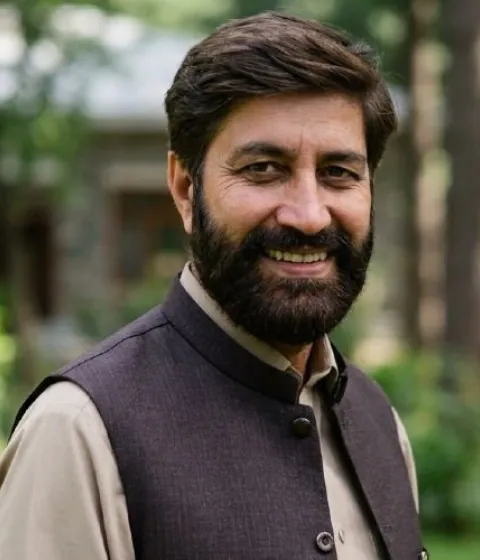
Anees Ahmad Khan
Chief Executive Officer
Board of Directors
-
Shakeel Ahmed
Chairman
Regional Program Manager SRSP
-
Qazi Ghazanfar Khan
Member
Lawyer by profession, currently Judge in Peshawar High Court
-
Iffat Jamil
Member
Program Unit Manager Plan Intl.
-
Saeed uz Zaman
Member
Retired Chief Conservator Wildlife KPK, now Consultant Development/NRM
-
Naheed Khan
Member
Development Professional
-
Anees Ahmad Khan
Member /CEO
Development Professional
Learn more
Explore Haashar
-
Our History
Haashar Association traces its roots back to the forestry sector reforms initiated under the Siran Kaghan Forestry Development Project from 1992-2000.
Read more -
Mission, Vision & Values
Our Mission: To catalyze and enable marginalized rural communities for inducing sustained socio-economic change and lasting improvements in their lives.
Read more -
Our Approach
Within the broad framework of community development through integrated natural resource management, livelihoods improvements and capacity building, Haashar follows’ following steps to implement its…
Read more -
Conceptual Framework
Haashar will actively promote participatory, open and self managed structures and behaviors. Throughout the organization there will be flat organization structures that minimize reporting layers and…
Read more -
CEO’s Message
Haashar Association shares the honor with our valued stakeholders for completing decade of success, service and sustainability.
Read more -
Governance & Accountability
Haashar’s Board of Directors comprises of 06 members with adequate gender representation (currently comprises of 4 male and 3 female members) who have diverse professional background and working…
Read more -
Community Organisations in Siran Valley
S#No Village Male CBO Female CBO 1 Dadar Chock Taraqee Tanzeem Dadar Dahi Tanzeem Baraey Khawateen Dadar Chock 2 Dadar Dahi Tanzeem Dadar 3 Basala Ittefiaq Tanzeem Basala Dahi Tanzeem Basala 4 Chambr…
Read more -
Our team
Meet the staff and the Board of Directors behind Haashar’s work.
Meet the team